Wednesday, January 3, 2018

Answering Questions on Colossians 1 & John 8:58 and the New World Translation Bible


Question: Let's begin.  In reference to Col l:15-17 your answer was all bibles insert the word "other" where translators feel it is needed.  The KJV does it 67 times, the RSV 100 times, etc.  Well this is true, but they do not use it in this passage.  Now here is the first question.
 Why is the word "other" inserted in this passage.  Again there are two words Paul could have used if he wanted to show that Jesus was another.  First is Allos which means another of the same kind (#243 Strongs Con)  Next is Heteres means another of a different kind (#2087-2088)  By using brackets NWT acknowledges that it is not in Greek.  There is no linguistic reason at all to insert this word here four times.... unless you are trying to support the presupposition that Jesus is not God.

Reply: Col 1:20 says  that Jesus will "reconcile all things unto himself." Will he also reconcile Satan unto himself? No! That is because there are exceptions to the word ALL/PAS/PANTA.
Why doesn't the Greek text uses ALLOS or hETEROS here? Because "other" is a legitimate part of PAS/PANTA.

In fact, had you bothered to investigate  the additions of "other" in the RSV, KJV etc., you would have seen that it most often followed PAS/PANTA, just like it does in the NWT. [The New Living Translation adds the word "else" in verse 17, "He existed before everything else began"] In fact, I have gone so far as to check every occurence of ALLOS and hETEROS in the Greek text, and I could not find any occurence of these words alongside PAS/PANTA. Obviously, it was not common to do so, showing again, the superiority of the NWT.
As we can see, the linguistic reason here is strengthened by the fact that Jesus here (verse 15) is the firstborn, a part of creation.

Question: Why do you interpret the word "first born" to mean first created.  This is not correct because there is a Greek word for "First Created" and it was not used.  The Greek for firstborn is proto with tikto:  Firstborn.  The Greek for first created would be proto with ktizo:  first created.  Paul did not use the second but the first. (3)  Your comments please.

Reply: Again, you are falling into the trap you did with ALLOS and hETEROS. Protoktizo was not in common use back in the first century, and would not be for a 100 to 200 years after Christ. Interestingly though, when this word was eventually used, it was used of Christ. John Patrick, in his Clement of Alexandria notes:

    "Clement repeatedly identifies the Word with the Wisdom of God, and yet refers to Wisdom as the first-created of God; while in one passage he attaches the epithet "First-created," and in another "First-begotten," to the Word." p.103,104, note 6.

The Philosophy of the Church Fathers, Volume 1 Faith, Trinity, Incarnation, by Harry Austryn Wolfson, 2nd Edition, Revised:

    "Zahn casually remarks that Clement 'always makes a sharp distinction between the only uncreated God the Father and the Son or Logos who was begotten or created before the rest of creation.'...1. cf. Th. Zahn, "Supplementum Clementinium", (1884), 144, p. 204, 92
    "It is undoubtably with reference to this "coming forth" of the Logos prior to the creation of the world that Clement speaks of the Logos as "firstborn" [protogonos] and of wisdom, which he idtentified with the Logos, as the "first-created" [protoktistos]...30 Strom. VI, Ibid. V. 14., ibid. p 209

The prototokos in Col 1:15 is a partitive genitive. Let us look at the Greek here, "hos estin eikOn tou theou tou aoratou, prOtotokos [firstborn]  pasEs [of all] ktiseOs [creation]"
All the words in red are genitives, but the ones we are interested in are the ones following prOtotokos. This means "firstborn" is in the genitive construction, hence we have the translation, "firstborn of." When checking this with other uses in the LXX (Septuagint), the outcome is devastating for Trinitarians, as "firstborn of" always indicates that the referent is part of the class or group it is joined to.
For example: LXX Genesis 4:4 And Abel also brought of the first born of his sheep
(This makes the firstborn a member, or part, of the sheep)
LXX Exodus 11:5 And every first-born in the land of Egypt shall die, from the first-born of Pharao that sits on the throne, even to the first-born of the woman-servant that is by the mill, and to the first-born of all cattle.
(The firstborn of Pharoah is of the house of Pharoah, the firstborn of cattle was one of the cows, etc).
There are no exceptions to this. Jesus, as the firstborn of creation, is a member of creation, he is a created being.
When the NIV translates Col 1:15 as "the firstborn over all creation," it is actually being dishonest and biased.

Question:     Next in reference to John 8:58 in the 1969 Kit the footnote reads, "This is not the Being, or the "I Am" at Exodus 3:14.  Also in the 1985 Kit appendix 2F, page 1145 it reads, "Attempting to identify Jesus with Jehovah some say that "E-GOEI-MI is the equivalent of the Hebrew expression "I Am" which is used by God.
Where is the NWT is the Hebrew expression "I Am" that was used by God?  And if it is in Exodus 3:14
Why was it changed to I shall prove to Be?  If Jesus was not using the divine name used by God in Exodus 3:14 KJV "I Am", and if he was not claiming to be God in John 8:58/10:30-33

Reply: The expression "I am" is indeed used by God, as it is also used of those who are not God. [Even in the NWT, looking up phrases like "I am Jehovah" will bring back a positive result]
A few verses after Jesus' statement in John 8:58, a blind beggar also uses the words I AM/EGW EIMI. Does this make him God?
Let me ask you a question. In Exodus 3:12 we have the same Hebrew words that we have in verse 14. But in verse 12, in most of the Bibles I own, it is translated "I will be." Yet, 2 verses later, it is translated "I AM. Why was it changed to I AM? It seems the NWT (and Moffatt etc) are the only ones consistent here.

Question: What misunderstanding did they have about what it was Jesus said that led them to claim that he was making himself out to be God?

Reply: In John 8, they never understood Jesus as claiming to be God. In John 10:30-33, Jesus quoted Psalm 82 where even Judges are called gods. Like Ryrie says of John 10:34, "Christ's point is that if the O.T. uses the word "God" (Elohim) of men who were representative of God, then the Jews should not oppose Him for calling Himself the Son of God." If Jesus were really "Equal to God" as the Jews have wrongly claimed by making God his Father, then here would have been a great opportunity to explain the Trinity to an unbelieving nation. But what does he do? He answers, "The Son can do nothing of himself, but what he seeth the Father doing. No explanation whatsoever of a Triune Deity. Amazing!

Question: Also, why did the soldiers fall to the ground in John 18:5-6?

Reply: "As Jesus said to them, 'I am he,' they retreated and fell to the ground." NAB
Maybe they tripped over each other, the Bible does not explain, but it was probably for the reason mentioned in the NIV Study Bible, "They came to arrest a peasant, but they were met in the dim light by a majestic person."
Jesus uses EGW EIMI 5 times in John 8, yet no one ever lost their footing. Does this mean that we should read into this that Jesus was claiming to be God the Son, the second person of a triune deity? Don't be silly.
We should be thankful that Jesus was not the Almighty, as then they would have died (Ex 33:20). Even when Moses was approached in Exodus 3, it was actually an angel doing all the talking (see verse 2 and Acts 7:30). 

Tuesday, January 2, 2018

On the Words "ONOMA" and "Savoir" and "Greater" in the Bible


Question: In Mt 1:23, who is Matthew referring to here that has been given the name which means "With Us Is God"?

Reply: Simply naming someone Imanuel does not make him God anymore than naming someone Jehu (meaning "Jehovah is He") makes someone Jehovah.

Question: The Bible says that ONLY God is our savior (Hos 13:4, Isa 43:11,45:21, etc.). How can it be then, that the Bible repeatedly says that Jesus Christ is our savior (Lk 2:11, Phil 3:20. Tit 2:13, 3:6, 2Pet 1:1, 2:20, 3:18, etc.)?

Reply: For the same reason Jehovah raised up saviours in the past:
"And when the Israelites cried out to the LORD, he raised for them a savior, Othniel, son of  Caleb's younger brother, Kenaz." Judges 3:9, 15 NAB
"...he raised for them a savior, the Benjaminite Ehud" Judges 3:15
"Therefore thou deliveredst them into the hand of their adversaries, who distressed them: and in the time of their trouble, when they cried unto thee, thou heardest from heaven; and according to thy manifold mercies thou gavest them saviours who saved them out of the hand of their adversaries." Neh 9:27
 Why, the very name "Jesus" points to God as the source of salvation. It means "Jehovah Is Salvation" and thus honors the Father as the Saviour to whom even the Son looked.
The Bible as a whole thus makes it clear that there is but one Saviour, Jehovah God. All others who have rightly been called saviours, including Jesus Christ, are not rival saviours. Rather, they were willing to be used by Jehovah God in this capacity. Hence, those desiring to gain divine approval must acknowledge that salvation proceeds from the Father through his Son, the Lord Jesus Christ.
"This is good and pleasing to God our Saviour; who will everyone to be saved, and come to the knowledge of the truth. For there is one God, there is also one mediator between God and the human race, Christ Jesus, himself human." 1Tim 2:3-5 NAB

Question: If Christ was created by God and was the wisdom of God (Prov 8:1-4, 12, 22-31), then before Jesus would have been created, God would have had to have been without wisdom. How is it possible that God could have ever been without wisdom?

Reply: Actually, it has been primarily Catholics like the questioner here that have touted Jesus as Wisdom. I can just as easily turn this around and ask, why, if God always had wisdom, does the Catholic Bible say that Yahweh created wisdom (NJB) at the above scriptures. Obviously, it is a different wisdom, a personified one, because in Prov 8...Wisdom speaks...and talks of its enjoyment with Yahweh its creator.

Statement: Matt 28:19 says that we are to baptise in the name (onoma is the singular form of name in the Greek) of the Father, Son, and Holy Spirit.

Reply: Using a singular form of NAME does not necessarily denote singularity.
Genesis 5:2 "Male and female created he them: and blessed them, and called their NAME Adam, in the day when they were created."
Here two distinct and separate individuals are called by one NAME.
Genesis 48:6 "And thy issue, that thou begettest after them, shall be thine; they shall be called after the name of their brethren in their inheritance." All the brothers had
different names although the text represents that by the singular, "name".
It is interesting that the NIV and NEB distributes the term by translating it "names".
Genesis 48:16: "The Angel which redeemed me from all evil, bless the lads; and let my name be named on them, and the name of my fathers Abraham and Isaac; and let them grow into a mulititude in the midst of the earth." Did Abraham and Isaac have the same name? Clearly, the singular term here "name" is used in a distributive sense.
Mark 5:9: "Then Jesus asked him, ‘What is your name?’ ‘My name is Legion,’ he replied, ‘For we are many.’" In this case one name was given to a plural number of distinct demons.

The Bible clearly distinguishes between the name of the Father and the name of the Son.
Proverbs 30:4 (NIV):" Who has gone up to heaven and come down? Who has gathered up the wind in the hollow of his hands? Who has wrapped up the waters in his cloak? Who has established all the ends of the earth? What is HIS NAME, AND THE NAME OF HIS SON? Tell me if you know!"
Hebrews 1:4 (New Jerusalem): "So he is now as far above the angels as the title which he has inherited is higher than THEIR OWN NAME."
Revelation 14:1 (NIV): "Then I looked, and theme before me was the Lamb, standing on Mount Zion, and with him 144,000 who had HIS NAME AND HIS FATHER’S NAME written on their foreheads." It is quite obvious that the Father has one name and that the Son has another.
To look for anything else in Matt 28:19 also ignores the "authority" that is placed within the lexical range of ONOMA itself.

Statement: Jesus says, "...the Father is greater than I am." (John 14:28) This refers to the Father having a greater position when Christ was on earth. He did not say that the Father is better than Him because they are equal in essence.

Reply: But the text does not say that this only refers to Christ when he was on earth. This is a 4th century interpretation read back into this verse. Jesus showed us how to use this same Greek word right in the next chapter, "Remember the word that I said unto you, A servant is not greater than his lord." A relationship between servant and his lord is one of rank, authority and superiority.

Is this the same for Jn 14:28? In the Grimm-Thayer Lexicon, it says of John 14:28 that MEIZON "is used of those who surpass others-either in nature and power, as God"p. 395
The same word is used at John 1:50. "Jesus said...thou shalt see greater things than these."
Then Jesus continues, "And he saith unto him, Verily, verily, I say unto you, Ye shall see the heaven opened, and the angels of God ascending and descending upon the Son of man." Is heaven not BETTER than anything we have yet seen?

It is unfortunate that many have to change the common meanings of words to buttress an errant theology.

Monday, January 1, 2018

More on the New World Translation Bible and Luke 23:43


Originally posted at http://www.webshowplace.com/question/65quest.html

Question: Jesus uses the phrase "Truly I say to you,..." over 50 times in the Bible. In the NWT, the comma is placed after the word "you" every time except in Lk 23:43, where the comma is placed after the word "today". Why is the comma placed after "today" instead of after "you" in this verse? If the translation of this phrase in Lk 23:43 was consistent with the translation of this phrase in all the other verses in which it appears (see concordance), and the comma was placed after the word "you", how would it read?

Reply: The above is neither accurate nor fair. The original languages did not have commas, so it is left up to the translator to determine where to put the comma. In the book How To Enjoy The Bible by E. W. Bullinger, it states, "The word 'verily'[truly] points us to the solemnity of the occasion, and to the importance of what is about to be said. The solemn circumstance under which the words were uttered marked the wonderful faith of the dying malefactor; and the Lord referred to this by connecting the word 'to-day' with 'I say.' 'Verily, I say unto to thee this day.' This day, when all seems lost, and there is no hope; this day, when instead of reigning I am about to die. This day, I say to thee, 'Thou shalt be with me in paradise.'
'I say unto thee this day' was the common Hebrew idiom for emphasizing the occasion of making a solemn statement(see Deut. iv. 26, 39, 40; v. 1; vi. 6; vii.11; viii. 1; 11, 19; ix. 3; x. 13; xi. 2, 8, 13, 26, 27, 28, 32; xiii. 18; xv. 5; xix. 9; xxvi. 3, 16, 18; xxvii. 1, 4, 10; xxviii. 1, 13, 14, 15;  xxix. 12; xxx. 2, 8, 11, 15, 16, 18, 19; xxxii. 46). p. 48  5th ed. 1921

 See also Syriac versions of the Bible, along with Rotherham, Concordant Literal NT and The Riverside New Testament.

Greg Stafford, in his book "Jehovah's Witnesses Defended. Elihu Books," makes an excellent point with regards to the "precise wording of the text." He says on page 552 that "Luke 23:43 is the only instance apart from Luke 23:34 where a verb of speech is used with semeron and where hoti does not separate it from that verb."

Below is the Vatican Manuscript 1209 (one of the oldest surviving mss) and they have placed the comma similarly to the NWT.
Other sources:

Tines men houtos anaginoskousin* _Amen lego soi semeron*_ kai hypostizousin* eita epipherousin, hotiet' emou ese e to paradeiso._("Some indeed read this way: 'Truly I tell you today,' and put a comma; then they add: 'You will be with me in Paradise.'"--Hesychius of Jerusalem, an ecclessiastical writer who died about 434 C.E. Greek text found in Patrologia Graeca, Vol. 93, columns 432, 1433.

Alloi de ekbiazontai to rhema, stizontes eis to <<Semeron,>> hin' e to legomenon toiouton* <<Amen ego soi semeron*>> eita to, <<met' emou ese en to paradeiso,>> epipherontes. ("But others press upon the saying, putting a punctuation mark after 'today,' so that it would be said this way: 'Truly I tell you today'; and then they add the expression: 'You will be with me in Paradise.'")--Theophylact, an ecclessistical writer who died about 1112 C.E. Edition: Patrologia Graeca, Vol. 123, column 1104.

Alloi -- to rheton ekbiazontai* legousin gar dein hypostizontas (254: hypostizantas) anaginoskein* amen lego soi semeron*>> eith' houtos epipherein to* met' emou ese etc. ("Others press upon what is spoken; for they say it must read by putting a comma thus: 'Truly I tell you today,' and then adding the expression this way: 'You will be with me' etc.")--Scholia 237, 239, 254. Text found in Novum Testamentum Graece, editio octava critica maior, by C. Tischendorf, Vol. I, Leipzig, 1869, under Luke 23:43.

Kai eutys eipen moi hoti amen amen semeron lego soi, met' emou ese en to parad[eiso]. ("And immediately he said to me: 'Most truly today I tell you, You will be with me in Paradise.'")--Descent into Hades, an apocryphal writing of the fourth century C.E. Text found in Novum Testamentum Graece, editio octava critica maior, by C. Tischendorf, Vol. I, Leipzig,869, under Luke 23:43.

Ho de eipen auto* semeron lego soi aletheian hina se ekho eis ton parad[eison] met' emou. ("And he said to him: 'Today I tell you the truth, that I should have you in Paradise with me.'")--Gospel of Nicodemus (=Acts of Pilate)b287, an apocryphal writing of the fourth or fifth century C.E. Text found in Novum Testamentum Graece, editio octava critica maior, by C. Tischendorf, Vol. I, Leipzig, 1869, under Luke 23:43.

Therefore, at least from the fourth century C.E. until well into the twelfth century C.E. there were readers who understood the text at Luke 23:43 as "Truly I tell you today, You will be with me in Paradise." On that very day, when Jesus died, he was in Sheol or Hades, and not in Paradise. (Psalms 16:8-11; Acts 2:22-32) He was dead and in the tomb until the third day and was then resurrected as "the firstfruits" of the resurrection. (Acts 10:40; 1 Corinthians 15:20; Colossians 1:18) Thus, the word "today" at Luke 23:43 does not give the time of the evildoer's being with Jesus in Paradise.

Or as the great commentarian Adam Clarke puts it:

To-day shalt thou be with me in paradise.] Marcion and the Manichees are reported to have left this verse out of their copies of this evangelist. This saying of our Lord is justly considered as a strong proof of the immateriality of the soul; and it is no wonder that those who have embraced the contrary opinion should endeavour to explain away this meaning. In order to do this, a comma is placed after shmeron, to-day, and then our Lord is supposed to have meant, "Thou shalt be with me after the resurrection I tell thee this, TO-DAY." I am sorry to find men-of great learning and abilities attempting to support this most feeble and worthless criticism. Such support a good cause cannot need; and, in my opinion, even a bad cause must be discredited by it.

Sunday, December 31, 2017

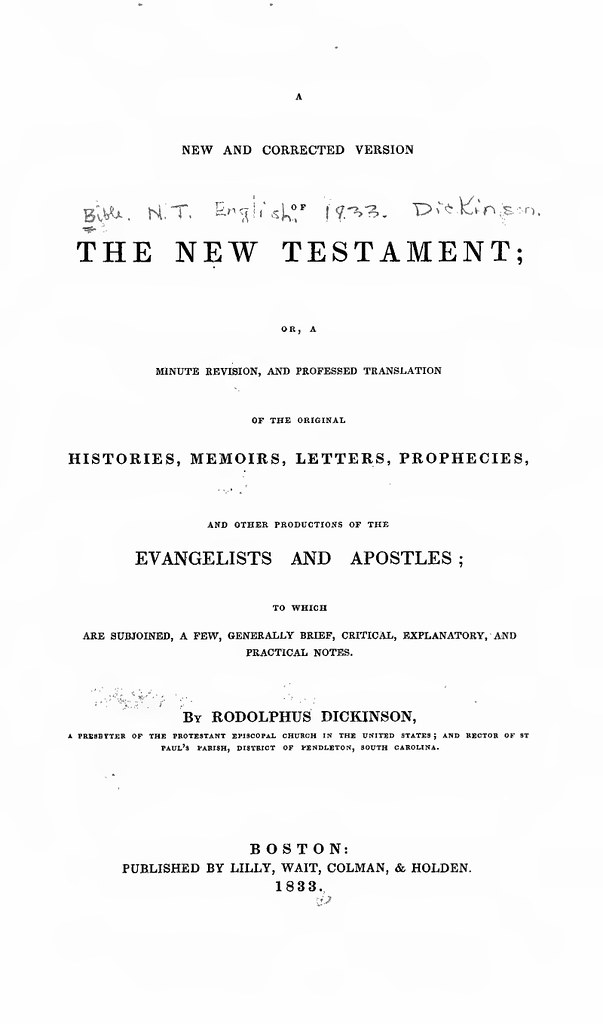
Rodolphus Dickinson's Snobbish 1833 Bible


Rodolphus Dickinson's Strange Bible

Quirky and queer Bible Versions are not new. In a world where we have Gay Bibles, Twitter Bibles, Klingon Bibles, Rodolphus Dickinson's Bible (1833) may not seem so strange after all. Rodolphus Dickinson (1787-1863) only sought to make a version of the New Testament agreeable to the well-born, or as he put it: 

"Accomplished and refined persons...And when it is considered what an antiquated, and in other particulars forbidding aspect, the inspired writings, in their usual style and conformation, present to the view of many intelligent, refined and amiable persons, who might be induced to peruse them in a less interrupted and more inviting form, in connexion with the typographical execution here displayed, which, it is presumed, will be regarded by such, as no small improvement; can any valid objection be urged to the prevalent spirit and character of this undertaking? Why should the inestimable gift of God to man, be proffered in a mode that is unnecessarily repulsive? Why should the received translation be permitted to perpetuate, to legalize, and almost to sanctify, many and unquestionable defects? While various other works, and especially those of the most trivial attainment, are diligently adorned with a splendid and sweetly flowing diction, why should the mere, uninteresting identity and paucity of language be so exclusively employed, in rendering the word of God? Why should the Christian scriptures be divested even of decent ornament? Why should not an edition of the heavenly institutes be furnished for the reading-room, saloon, and toilet, as well as for the church, school, and nursery? for the literary and accomplished gentleman, as well as for the plain and unlettered citizen? Why should the Bible be stationary, amid the progress of refinement and letters? Why, in antique fashion, should it remain solitary, in the enchanting and illimitable field of modern improvements?"

And speaking of himself:

"It is a source of self-gratulation, that a happy concurrence of events has, for a considerable period, placed me in a situation, which by withdrawing me from the contentions on theological topics, that have long distracted so great a portion of our country, has conduced to cherish a dispassionate spirit, and enabled me, in coincidence with my course of reading and reflection, to approach this undertaking, with views propitious to the cause of ingenuousness, truth, integrity, and impartial observation; and with a mind unperverted by disgusting, sectarian singularities I have also disdained the obsequious and servile predicament, of floating, at random, in the wake of others. The original has been my compass, the commentaries, my explanatory chart; and the principles of the highest authorities, my general guide; and ever reserving to myself, in its most unshackled exercise, the invaluable privilege of private judgment."

It is no wonder that Michael Marlowe wonderfully calls this New Testament, "A foppish translation by an Episcopal rector."

Let us then take a look at some examples of this translation:

From Matthew 5: You have heard that it was announced to the ancients. Thou shalt do no murder, and he who commits it, will be amenable to the judges. But I affirm to you, that every one, malignantly incensed with his brother, will be liable to the judges; and he who shall denounce his brother as a miscreant, will be subject to the sanhedrin; but he who shall denounce him as an abandoned apostate, will be exposed to the gehenna of fire.

From Matthew 13: The kingdom of heaven may be compared to a field, in which the proprietor had sown good grain; but while people were asleep, his enemy came and sowed darnel among the wheat, and departed. And when the blade germinated and put forth the ear, then the darnel also appeared.

From Matthew 25: [My arrival] may, therefore, be illustrated by a man, who intending to take a distant journey, called his own servants, and delivered to them his effects....And his master said to him. Well-done, good and provident servant! you was faithful in a limited sphere, I will give you a more extensive superintendence; participate in the happiness of your master.

From Luke 1: And it happened, that when Elizabeth heard the salutation of Mary, the embryo was joyfully agitated; and Elizabeth was pervaded by the Holy Spirit; and she exclaimed with a loud voice, and said, Blessed are you among women! and blessed is your incipient offspring! And whence this occurrence to me, that the mother of my Lord should visit me? For behold, when the voice of your salutation sounded in my ears, the embryo was enlivened with joy.

From Luke 2: And all who heard him, were in a transport of admiration at his intelligence and replies.

From Luke 2: And the approbation of all was awarded him; and they admired the elegance of language, that flowed from his lips.
From Luke 4:  And the approbation of all was awarded him; and they admired the elegance of language, that flowed from his lips.

From Luke 8: And it afterwards occurred, that Jesus travelled through every city and village [of Galilee], proclaiming and elucidating the joyful intelligence of the kingdom of God

From John 3: Teacher, we know that thou art an instructer emanated from God; for no one can achieve these miracles which thou performest, unless God be with him. Jesus answered and said to him. Indeed, I assure you, that except a man be reproduced, he cannot realize the reign of God. Nicodemus says to him, How can a man be produced when he is mature? Can he again pass into a state of embryo, and be produced? Jesus replied, I most assuredly declare to you, that unless a man be produced of water and of the Spirit, he cannot enter the kingdom of God.

From Acts 1: Moreover, this man, indeed, caused a field to be purchased with the recompense of his iniquity; and falling prostrate, a violent, internal spasm ensued, and all his viscera were emitted.

From Acts 17: Paul then stood in the centre of the court of Areopagus, and remarked; Men of Athens, I perceive that you are greatly devoted to the worship of invisible powers.

From Acts 26: Festus declared with a loud voice, Paul, you are insane! Multiplied research drives you to distraction.

From Acts 28: And the Barbarians displayed towards us no ordinary philanthropy.

Matthew 22: And while the pharisees were assembled, Jesus thus questioned them. What are your views relative to the Messiah? whose son should he be? They answer him. The son of David. He says to them. How then does David, by inspiration, call him His Lord; saying, Jehovah said to my Lord, Sit thou at my right hand, till I make thy foes thy footstool? If the Messiah were David's son, would David call him his Lord? And to this no one could answer him; nor did any one from that time, presume further to question him.
 

And from Ephesians we have this very long sentence:

"On this account, I also, having heard of your faith in the Lord Jesus, and love to all the saints, cease not to offer thanks for you, particularly referring to you in my prayers, that the God of our Lord Jesus Christ,  the Father of glory, would give you a spirit of wisdom and revelation in the acknowledgment of him; cause the eyes of your heart to be enlightened; that you may know what is the hope of his invitation, and what is the glorious abundance of his proffered inheritance among the saints; and what is the transcendent greatness of his power towards us who believe, according to the operation of his powerful energy, which he exerted in Christ, when he raised him from the dead, and seated him at his own right hand in the celestial regions; far above all empire, and authority, and power, and dominion, and every name that is given, not only in this, but also in the future world; and has subjected all things under his feet, and constituted him head over all things to the church, which is his body, the plenitude of him who accomplishes all things: and has reanimated you, who were dead in transgressions and sins, in which you formerly walked according to the practice of this world, according to the prince of the power of the air, the spirit that now operates powerfully in the sons of disobedience: among whom we all likewise once lived, in the propensities of our flesh, fulfilling the dictates of the flesh and of the passions; and were by nature children of displeasure, even as others."

See also 100 Rare American Bible Versions & Translations on DVDrom


For a list of all of my disks and ebooks (PDF and Amazon) click here

Visit https://newworldtranslation.blogspot.com/

Saturday, December 30, 2017

An Alternative View of the Alpha and Omega and Jesus Christ


Originally posted at http://www.webshowplace.com/question/65quest.html

Question: In Rev 22:12-13, Jesus Christ, the one who is "coming quickly", says of himself," I am the Alpha and the Omega, the first and the last, the beginning and the end". In Rev 1:17-18, Jesus, the one who "became dead, but, look! I am living forever and ever", refers to himself as the first and the last. Rev 21:6, in speaking of God, says, "...I am the Alpha and the Omega, the beginning and the end .,.". God is also referred to as the "first" and the
"last" in Isa 44:6 and Isa 48:12. How can this be since by definition of these words there can only be one first and one last?

Reply: Revelation 22:12-13 does not have Jesus speaking, but his Father, God. In fact, this verse is speaking of Jehovah in Isaiah 40:10, but referring to his son, the Arm of Jehovah.

"Behold, the Lord Jehovah will come as a mighty one, and his arm will rule for him: Behold, his reward is with him, and his recompense before him." ASV

I am not alone in this. The following references agree with me by noting the relevance of Isaiah 40:10 to Revelation 22:12 in the marginal references:
· The Nestle-Aland Greek Text (27th edition).
· The Jerusalem Bible.
· The New American Bible.
· The New American Standard Bible (1973, reference edition)

Compare that with Isaiah 53:1, 5, "Who hath believed our message? and to whom hath the arm of Jehovah been revealed?...But he was wounded for our transgressions, he was bruised for our iniquities; the chastisement of our peace was upon him; and with his stripes we are healed." [see also John 12:38]

Here, along with Is 40:10, we have the "arm of Jehovah" as being the Messiah and differentiated from his Father, Jehovah. Remember, Jehovah is the Father (Is 64:8), which, according to Trinitarian theology, the Son cannot be. When you take the entire book of Revelation into consideration, the conclusion that Jesus is the Lord God is not even possible.  Jesus cannot be the very God who is *his* God (Rev. 1:6; 3:2; 3:12).  The Father's superiority to Christ is shown in the very first verse of Revelation, where Christ is described as one who was *given*
knowledge by God.  Then come the aforementioned verses where the Father is described as Christ's God.  Finally, in recognition of this, in chapter 15 vs 3 we find Christ joining Moses as they sing a song of *praise* to his God and Father, who Christ himself calls "the Almighty."

But why do they both bear the title "first and the last, beginning and the end?"

Well, how have others in the past viewed this?

                    "Principium Christus, quia ipse inchoavit perficienda; finis
                    Christus, quia ipse perficit inchoata"; [that is] "Christ is
                    the beginning, because he himself commenced the work to be
                    accomplished; Christ is the end, because he accomplished the
                    work begun."--(Fulgentius (the Latin Father), Ad Transimundum,
                    Lib. II. c. 5; in Migne's Patrol. Tom. LXV. vol. 250, C. [as
                    quoted by Snedeker, ibid])
                    The First and the Last
                    "Attend well to the comfortable words of your heavenly Master,
                    whom God has appointed to be the original Lord, the continual
                    Preserver, and at last the righteous Judge of
                    mankind"--(Thomas Pyle, M.A., Paraphrases on the Acts, the
                    Epistles, and the Revelation, New edit. Oxford, 1817 [quoted
                    in Concessions, by John Wilson])

                    "...the first, that is, chief in dignity, having much greater
                    power than any one before possessed...the last, that is, the
                    most despised of men, Isa. liii. 3; having been betrayed,
                    mocked, beaten, scourged, and even condemned to be punished as
                    a slave"--(Hugo Grotius, Annotationes ad Vetus et Novum
                    Testamentum. [quoted in Concessions])

                    "Christ is called, in the Apocalypse, chap. i. 17, the first
                    and the last; and this expression, if taken in the same sense
                    as that in which it is used, Isa. xli.4; xliv.6; xlviii. 12,
                    may denote Christ's eternal Godhead.  Yet it is not absolutely
                    decisive; for the meaning of chap. i.17 may be, "Fear not; I
                    am the first (whom thou knewest as mortal), and the last (whom
                    thou now seest immortal), still the same, whom thou knewest
                    from the beginning."  The same explanation may be given of
                    chap. ii. 8, where the expression, the first and the last,
                    again occurs, and is used in connection with Christ's
                    resurrection from the dead.--(J.D. Michaelis: Introduction to
                    the New Test., vol. iv. pp. 539-40. [as quoted in
                    Concessions])

All of these examples show that there have even been trinitarians who have not viewed these titles as denoting any ontological oneness of identity between Christ and the Father.  The last example, by Michaelis, is especially interesting, because he realizes that the title "first and last" was being applied to Christ in reference to his death and resurrection. This is how I view it, though in a slightly different manner, namely, that Christ is the first to be resurrected by the Father directly, and last to be so resurrected. All references to Jesus as being the "first and the last" have this limitation. Let us take a look?  "I am the first and the last, and the Living one; and I was dead" Rev 1:17,18 "These things saith the first and the last, who was dead, and lived [again]" Rev. 2:8

"Jesus Christ, [who is] the faithful witness, the firstborn of the dead" Rev 1:5 See also Romans 14:9 and Col 1:18.

Can you really believe that God can die? I cannot. Hab 1:12, (before the scribal changes/ Tiqqune Sopherim) reads, "Art not thou from everlasting, O Jehovah my God, my Holy One? you do not die." see also New Jerusalem Bible. I believe that almighty God cannot be confined by his own creation. Since God created life, and death is a by-product of life, this would be included. The Bible never speaks of only Jesus' human-self/human nature/second nature dying. This is a later thought that is read back into the scriptures.

metatron3@gmail.com

Answers to Questions asked using the New World Translation Bible


Answers to Questions asked using the NWT

Originally posted at http://www.webshowplace.com/question/65quest.html

It appears this site is Catholic, or at least sympathetic to them, so my answers will approach the issues from that angle.
All MY answers, unless otherwise stated, all scriptures are from the following Catholic Bibles: NJB (New Jerusalem Bible), NAB (New American Bible),  Spencer (New Testament of our Lord and Saviour Jesus Christ by Francis Aloysius Spencer, 1940), K&Lilly (The New Testament Rendered from the Original Greek by Kleist and Lilly, 1956) and references to McKenzie are to the Dictionary of the Bible, Touchstone, 1995, and references to NWDC are from the New World Dictionary to the New American Bible, 1970) all of which bear the Nihil Obstat and the Imprimatur giving them the approval of the Catholic Church.

Question: These questions have been put together using information from many different sources. All verses are from the NWT and if the NWT decides to change any of the verses (like they did with Heb 1:6), then the obvious question is why did the NWT change their Bible at Hebrews 1:6. [The NWT 1950 edition had: "And let all God's angels worship him" but in later editions "worship" was changed to “And let all God’s angels do obeisance to him.”)

Reply: Most Bibles I know make changes with each revision, like the Good News Bible, New International Version, New American Standard Bible, King James etc. The above complaint is obviously a reference to proskuneo in Heb 1:6. It is rendered "Let all the angels of God worship him" in the Jerusalem Bible, but changed to "Let all the angels of God pay him homage" in the New Jerusalem Bible. This is not the only Catholic Bible that has done this. The Confraternity Version had "And let all the angels of God adore him", but when it was updated in the New American Bible, it read, "Let all the angels of God worship him."

Question: If the Holy Spirit is God's impersonal "active force", why does he speak directly and refer to himself as "I" and "me" in Acts 13:2?

Reply: "Spirit is the principle of life and vital activity. The spirit is the breath of life (Gn 6:17; 7:15, 22; BS 38:23; WS 15:11, 16; 16:14). The breath is the breath of God, the wind, communicated to man by divine inspiration....The spirit of Yahweh or the spirit of God (Elohim) is a **force** that has unique effects upon man...and the spirit of Yahweh is a **force** which operates the works of Yahweh the savior and the judge. The spirit of Yahweh is often the **force** which inspires prophecy (Nm 11:17 ff; 24:2; 2 S 23:2; 1 Ch 12:18; Is 61:1; Mi 3:8; Ezk 2:2; 3:12, 14, 24; 8:3; 11:1, 5, 24; 37:1; 43:5; Ne 9:30; Zc 7:12). The prophet is a man of the spirit (Ho 9:7)." Dictionary of the Bible by Catholic Scholar, John L. McKenzie, S.J.
As we can see, the spirit is breath. In the Bible it is associated with "breath" and even "nostrils." (Gen 7:22; Job 27:3; 32:8; 33:4; 34:14; Is 42:5; Jn 20:22) When I speak, breath comes out of my mouth. This is my spirit, not a separate person.

Question: Col 1:16, in talking about Jesus, says that"... All [other] things have been created through him and FOR HIM". If Jesus were Michael the Archangel at the time of creation, would an angel have created all things for himself? Isa 43:7 says God created "everyone ... for my OWN glory ..."

Reply: But the Bible does not says he created all things FOR HIMSELF (AUTON) but FOR HIM (AUTOU). The NAB links this scripture and the surrounding ones with Prov 8, 22-31; Wis 7, 22-8, 1; and Sir 1, 4, so lets take a look at those.
"Yahweh created me, first-fruits of his fashioning, before the oldest of his works." Pr 8:22 NJB
"Then I was beside him as his craftsman, and I was his delight day after day." Pr 8:30 NAB
"For she [Wisdom] is an aura of the might of God and a pure effusion of the glory of the Almighty." Wis 7:25 NAB
"Before all things wisdom was created" Sir 1:4 NAB
The NJB has an interesting comment here at Prov 8, "Wisdom's creation by God was on a different plane to all his other works, Wisdom almost seems to be a distinct personality, sharing in God's activity, and his agent in the world. The concept given here will be used in the NT to express Christ's relationship to his Father."
So here we see that Christ/Wisdom was a created being who was God's agent in creation. The NAB even says in a footnote at Col 1:16, 17 that  "Christ (though not mentioned by name) is preeminent and supreme as God's agent in the creation of all things"
God was happy with Jesus/Wisdom (his delight). Jesus is part of God's glory (John 1:14), and we get to share in that glory, "I have given them the glory you gave me, that they may be one as we are one." John 17:22 NJB

Question: The NWT translates Jn 1:1 as "... and the Word was WITH God, and the word was a god." How can the Word (Jesus) be "a god' if God says in Deut 32:39, "See now that I -- I am he, and there are NO gods together with me..."?

Reply: But yet the Bible talks of others as gods, such as Moses (Ex 4:16; 7:1), angels (Ps 8:5; 97:7; 138:1) and King Solomon (Ps 45:6).  Deut 32 must be read in its historical context, which includes strange gods (v. 16), new gods (v. 17) and obviously, idols (v.  37).
The NAB-St. Joseph's Edition in a footnote at John 1:1 says that, "The Roman writer Pliny mentions the Christians of Asia Minor as singing hymns of Christ as *a god.*
The NAB also says at Ps. 45:7/Heb. 1:8, "The king in courtly language, is called 'god,' i.e., more than human, representing God to the people."
Though they of course believe in a Trinity, the NWDC candidly admits, "In the New Testament, the Greek Theos with the article (The God) means the Father of our Lord Jesus Christ (see Rom. 1:7; 1 Cor. 1:3; 2 Cor. 1:2; etc.). Thus God is almost the name of the first person of the blessed Trinity. Without the article, God designates the divinity, and so is applicable to the pre-existing Word (Jn. 1:3). The term God is applied to Jesus in only a few texts, and even their interpretation is under dispute (Jn. 20:28; Rom. 9:5; Tit. 2:13; 2 Pet. 1:1)."

Question: In Jn 20:28, John refers to Jesus in Greek as "Ho kyrios moy kai ho theos moy". This translates literally as "the Lord of me and THE God of me". Why does Jesus, in Jn 20:29, affirm Thomas for having come to this realization? If Jesus really wasn't the Lord and THE God of Thomas, why didn't Jesus correct him for making either a false assumption or a blasphemous statement?

Reply: Who says that Jesus cannot be a Lord, when Acts 2:36 says that God *MADE* him Lord, and how can he not be a god when John 1:18 calls him an "only-begotten God" (Spencer). But we know from the context of Jn 20:28 that Jesus calls his Father "my God." (v. 17) How can almighty God Jesus have a God...and one that is greater than him yet? (14:28) So let us look at Jn 20:28:
O KURIOS MOU KAI O QEOS MOU and compare it with Mt 12:49 H MHTHR MOU KAI OI ADELFOI MOU.
What does this mean? "In native [not translation] KOINE Greek when the copulative KAI connects two substantives of personal description in regimen [i.e. both or neither have articles] and the first substantive alone is modified by the personal pronoun in the genitive or repeated for perspicuity [Winer 147-148;155] two persons or groups of persons are in view."

Possessive pronoun repeated for perspicuity -
Mt 12:47, H MHTHR SOU KAI OI ADELFOI SOU/the mother of you and the brothers of you
49 H MHTHR MOU KAI OI ADELFOI MOU/the mother of me and the brothers of me
Mark 3:31, H MHTHR AUTOU KAI OI ADELFOI AUTOU/the mother of him and the brothers of him
32 H MHTHR SOU KAI OI ADELFOI SOU/the mother of you and the brothers of you
34 H MHTHR MOU KAI OI ADELFOI MOU/the mother of me and the brothers of me
Mk 6:4 TH PATRIDI AUTOU KAI EN TOIS SUGGENEUSIN AUTOU/the father of him and the relatives of him
7:10 TON PATERA SOU KAI THN MHTERA SOU/the father of you and the mother of you
Lk 8:20  H MHTHR SOU KAI OI ADELFOI SOU/the mother of thee and the brothers of thee
Lk 8:21  MHTHR MOU KAI ADELFOI MOU/mother of me and brothers of me
Jn 2:12 H MHTHR AUTOU KAI OI ADELFOI [AUTOU] KAI OI MAQHTAI AUTOU/the mother of him and the brothers of him and the disciples of him
Jn 4:12 OI UIOI AUTOU KAI TA QREMMATA AUTOU/the sons of him and the cattle of him
Acts 2:17 OI UIOI UMWN KAI AI QUGATERES UMWN/the sons of you and the daughters of you
Rom 16:21 TIMOQEOS O SUNERGOS MOU KAI LOUKIOS KAI IASWN KAI SWSIPATROS OI SUGGENEIS MOU/Timothy the fellow-worker of me of me and Lucius and Jason and Sosipater the kinsmen of me.
1 Thess. 3:11 QEOS KAI PATHR HMWN KAI O KURIOS HMWN IHSOUS/God and Father of us and the Lord of us Jesus.
2 Thess. 2:16 O KURIOS HMWN IHSOUS CRISTOS KAI [O] QEOS O PATHR HMWN/the Lord of us Jesus Christ and the God the Father of us
1 Tim. 1:1 QEOU SWTHROS HMWN KAI CRISTOU IHSOU THS ELPIDOS HMWN/God savior of us and Christ Jesus the hope of us
2 Tim 1:5 TH MAMMH SOU LWIDI KAI TH MHTRI SOU/the grandmother of thee Lois and the mother of thee Eunice
Heb 8:11 EKASTOS TON POLITHN AUTOU KAI EKASTOS TON ADELFON AUTOU/each one the citizen of him and each one the brother of him
Rev 6:11 OI SUNDOULOI AUTWN KAI OI ADELFOI AUTWN/the fellow-slaves of them and the brothers of them
[Heb 1:7 is a LXX quote and is therefore translation Greek.]

As we can see, everytime this same construction is used, it is refering to TWO different people. NO EXCEPTIONS!!

"Thomas answered and said unto Him, My Lord and my God." He saw and touched the man, and acknowledged the God whom he neither saw nor touched; but by the means of what he saw and touched, he now put far away from him every doubt, and believed the other." Augustine in "Tractate CXXI"

"It is extremely significant that on the one occasion where there is no argument, in the case of Thomas, the statement is not a theological proposition but a lovers cry; it is not the product of intellectual reasoning but of intense personal emotion." p. 33, Jesus As They Saw Him, by William Barclay
Some have taken Thomas's exclamation as directed towards the Father, hence you have, "My Master, and my God" as in the 20th Century NT.
Winer , as does Beza, thinks it is simply an exclamation, not an address. (see G.B. Winer, A Grammar of the Idiom of the New Testament, 1872, p. 183
Brown reads it as "my divine one" The Gospel According to John, 1966
Fortna finds a problem with the high Christology of v.28 and the more primitive messianism of v.31. (see The Gospel of Signs, 1970, pp. 197, 198
Burkitt paraphrases it as "It is Jesus himself, and now I recognize him as divine."
While I may not agree with Harris on everything, he does say, "Although in customary Johannine and NT usage (O) QEOS refers to the father, it is impossible that Thomas and John would be personally equating Jesus with the Father, for in the immediate historical and literary context Jesus himself has explicitly distinguished himself from God his Father." p. 124

 John Martin Creed, as Professor of Divinity in the University of Cambridge, observed: "The adoring exclamation of St. Thomas 'my Lord and my God' (Joh. xx. 28) is still not quite the same as an address to Christ as being without qualification God, and it must be balanced by the words of the risen Christ himself to Mary Magdalene (v. Joh 20:17): 'Go unto my brethren and say to them, I ascend unto my Father and your Father, and my God and your God.'"

The translator Hugh J. Schonfield doubts that Thomas said: "My Lord and my God!" And so in a footnote 6 on John 20:28 Schonfield says: "The author may have put this expression into the mouth of Thomas in response to the fact that the Emperor Domitian had insisted on having himself addressed as 'Our Lord and God', Suetonius' Domitian xiii."—See The Authentic New Testament, page 503.

AS Margret Davies says in her book RHETORIC AND REFERENCE IN THE FOURTH GOSPEL, 125-126,

    "Naturally, the interpretation of Thomas's words was hotly debated by early church theologians who wanted to use it in support of their own christological definitions. Those who understood "My Lord' to refer to Jesus, and 'my God' to refer to God[the Father], were suspected of heresy in the 5th cent CE. Many modern commentators have also rejected that interpretation and instead they understand the confession as an assertion that Jesus is both Lord and God. In doing so they are forced to interpret 'God' as a reference to LOGOS. But it is perfectly for Thomas to respond to Jesus' ressurection with a confession of faith both in Jesus as lord and in God who sent and raised Jesus. Interpreting the confession in this way actually makes much better sense in the context of the 4th gospel. In 14:1 beleif in both God and in Jesus is encouraged, in a context in which Thomas is particularly singled out.... If we understand Thomas's confession as an assertion that Jesus is God, this confession in 20:31 becomes an anti-climax."

Does Jn 20:28 say what trinitarians think it says? No. There is nothing there that talks of Jesus as being God the Son, the second person of a consubstantial Trinity.

    "For any Jew or Greek in the first century A.D. who was acquainted with the OT in Greek, the term QEOS would have seemed rich in content since it signified the Deity, the Creator of heaven and earth, and also could render the ineffable sacred name, Yahweh, the covenantal God, and yet was able of exremely diverse application, ranging from the images of pagan deities to the One true God of Israel, from heroic people to angelic beings. Whether one examines the Jewish or the Gentile use of the term QEOS up to the end of the 1st century A.D., there is an occasional application of the term to human beings who perform divine functions or display divine characteristics." Harris' Jesus as God, p.270

Don Cupitt describes the relationship between God and Jesus as "something like that between King and ambassador, employer and omnicompetent secretary, or Sultan and Grand Vizier. Christ's is God's right hand man; all God does he does through Christ, and all approach to God is through Christ. All traffic, both ways, between God and the world is routed through Christ." The Debate about Christ, p. 30

This reminds me of a scripture at II Kings 18:28 in the LXX, which reads:

    "And Achimaaz cried out and said to the king, Peace. And he did obeisance to the king with his face to the ground, and said, Blessed be the Lord thy God, who has delivered up the men that lifted up their hand against my lord the king." (Brenton)

Here we have Achimaaz bowing before the king, and exclaiming thanks to YHWH. No one here supposes that David is almighty God, and there is nothing strange about this type of vocalizing. Yet when Thomas does it, it carries all kinds of heavy theological baggage that was never intended in the framework of 1st Century Christianity.

    "...those who actually companied with Jesus found him fully and naturally a man. He did not seem to them to be some indeterminate person from some halfway land in which human and divine were intermingled; he did not seem to them a kind of Greek demigod, neither fully human or fully divine; he did not seem to them to be so divine as to be inhuman."  p.15,  Jesus As They Saw Him, by William Barclay

"The NT designation of Jesus as QEOS bears no relation to later Greek speculation about substance and natures." O. Cullman's Christology of the New Testament as quoted in Harris' Jesus as God, p.289.

If Thomas was actually calling Jesus hO QEOS and hO KURIOS--it is strange that Thomas used the nominative forms of KURIOS and QEOS instead of the vocative. So it still seems that Theodore of Mopsuestia could have been correct. The Father may well be the referent in John 20:28.

Do you remember and earlier conversation Jesus had with Thomas (and Phillip)? It was at John 14:5-9, and at verse 8 Philip said to Jesus, "Lord, show us the Father." and Jesus replied, "Anyone who has seen me has seen the Father." NJB

Nobody, including Trinitarians or Catholics believe that Jesus is his own Father. After all, verse 28 of the same chapter has Jesus saying, "The Father is greater than I." Thomas, after realizing like Paul, that it was "God the Father who raised Him from the dead," finally saw in Jesus the one way to approach the Father, just like Jesus was earlier trying to show to him. "No one comes to the Father, but by me." Jn 14:6 Spencer

Question: If the Holy Spirit is God's impersonal active force, how could he: Be referred to as "he"and "him" in Jn 16:7- 8 and Jn 16:13-14; Bear witness (Jn 15:26); Feel hurt (Isa 63:10); Be blasphemed against (Mk 3:29); Say things (Ezek 3:24, Acts 8:29, 10:19, 11:12, and Heb 10:15-17): Desire (Gal 5:17); Be outraged (Heb 10:29); Search (I Cor 2:10); Comfort (Acts 9:31); Be loved (Rom 15:30); Be lied to and be God (Acts 5:3-4)?

Reply: In the Bible, even the blind can see with "eyes of your understanding" by means of "the spirit of wisdom and revelation in the knowledge of him." Eph 1:17, 18
As we can see, the Bible employs terms that are descriptive, and often personifies the impersonal.
Sheol/Hell has a mouth and can swallow people (Numbers 16:30), it has ropes (2 Samuel 22:6), and it has soul (Isaiah 5:14).
"Sin lieth at the door. And unto thee shall be his desire" (Gen 4:7 KJV). Here SIN is given desire, it lies and it is referred to as "HIS."
Blood cries out (Gen 4:10).
Names can rot (Pr 10:7)
A man of wisdom will see God's name (Mic 6:9)
God's name is near (Ps 75:1)
The apostle Paul personalized sin and death and also undeserved kindness as "kings." (Ro 5:14, 17, 21; 6:12) He writes of sin as "receiving an inducement," 'working out covetousness,' 'seducing,' and 'killing.' (Ro 7:8-11)
Wisdom speaks (Prov 8)

...but is the spirit God according to Acts 5:3, 4?
Let us see what it says:
"Peter said, Ananias, how can Satan have so possessed you that you should lie to the Holy Spirit, and keep back part of the price of the land? While you still owned the land, wasn't it yours to keep, and after you had sold it wasn't the money yours to do with as you liked? What put this scheme into your mind? You have been lying, not to men, but to God." NJB

Do you notice that the last part is directed towards Peter when it says, "You have been lying not to men?" See, they lied to Peter, who was "filled with holy spirit" Acts 4:8
And when they lied to Peter, they lied to God. Later on, in the same chapter, we have a similar situation in vss 38 and 39 where these words were directed towards Peter and the disciples, "What I suggest therefore, is that you leave these men alone and let them go. If this enterprise, this movement of theirs, is of human origin, it will break up of its own accord; but if it does in fact come from God, you will be unable to destroy them. Take care not to find yourself fighting against God." Peter and his men were not God, but representative standing in place of God, and when something is done against them, it is done against God." NJB "Whoever touches you touches the apple of my eye." Zech 2:12 NJB
Acts 5 works quite well with 1 Thess 4:8 which says, "anyone who rejects this is rejecting not, but God, who gives you his Holy Spirit." NJB

Question:  What is the correct spelling of God's proper name, "Yahweh" or "Jehovah"? If [the translators of the NWT] maintain that "Yahweh" is more proper, why do they misspell it "Jehovah"? If the name of God is so important, then should you not only pronounce it correctly, but spell it correctly too?

Reply: The translators of the NWT also maintain, like many others, that Jesus was called Yeshua, yet but a few purists really call him that. The Catholic Jerusalem Bible at Ps 83:18 says that God is Yahweh, the Living Bible-Catholic Edition says it is Jehovah, and the Catholic New American Bible says it is LORD! If the name of God is so important to you, then should you not only pronounce it correctly, but spell/translate it correctly too?

Was Jesus Worshipped as a God? by Samuel J. May 1854


Was Jesus Worshipped as God? by Samuel J. May 1854

If my friend will consult the Greek Testament, he will find five words used, in different places, to. express the ideas we attach to the English word worship. These are, 1, proskuneo; 2, liturgeo; 3, latreuo; 4, sebomai; 5, proseuchomai.

Tbe first of these, "proskuneo," is used to express that respect which one man may show another man as his superior, his king, his ruler, or one on whom he is dependent for some great favor, which he hopes to receive. In the Septuagint translation of the Old Testament, and in the Greek original of the New Testament, this word, "proskuneo," is used in the following passages:

Gen. 23:7, 12, where Abraham is said to have bowed down himself to the people of the land, the children of Heth, from whom he wished to obtain a place to bury Sarah.

The same word is used 1st Chron. 29:20, where we read that "all the congregation blessed the Lord God of their fathers, and bowed down their heads and worshipped the Lord and the king."

The same word again is found in Daniel 2:46, thus: "Then the king Nebuchadnezzar fell upon his face and worshipped Daniel, and commanded that they should offer an oblation and sweet odors unto him."

In turning to the New Testament my friend will find that it is this word "proekuneo," that is used wherever there is anything said of the worship paid to Jesus. Matt. 8:2, "And behold there came a leper and worshipped him.

And in Heb. 1:6, where we read, "let all the angels of God worship him," i. e. the first-begotten.

Now that the word "proskuneo" is not used in the New Testament in any higher sense than in the Old, we learn from the following passages in Luke 14:10, Jesus had been instructing his disciples how they should conduct themselves when bidden to a feast, and he adds, "then shalt thou have worship in the presence of those who sit at meat with thee."

Matt. 18:26, where the servant in the parable, who owed his Lord ten thousand talents, "fell down and worshipped him."

So in Acts 10:25, "as Peter was coming in, Cornelins met him, and fell down at his feet and worshipped him."

In Rev. iii. 9, an assurance is given to the angel, or minister of the Church of Philadelphia, that the disobedient members of the Church shall "worship before thy feet and know that I have loved thee."

Now, let my opponent, or any ether advocate of the worship of Jesus, show, if he can, in what single instance either of those other words used to express the honor due to God alone, is applied to Christ, and then he will have at least some shadow of evidence for his doctrine. but at present he has none.

In all the cases I have adduced, the word proskuneo" is used. Even after Christ's resurrection from the dead, (Matt. 28:9th v.) when "his disciples came and held him by the feet and worshipped him," and also in the 17th verse, the word that is used is "proskuneo."

Upon this passage Dr. Adam Clarke, (whom I love to quote, because I suppose what he says will have much weight with my brother,) remarks as follows:

"This kind of reverence is in daily use among the Hindus; when a disciple meets a public guide in the streets, he prostrates himself before him, and, taking the dust from his teacher's feet, rubs it on his forehead, breast," &c.

And So, too, Dr. John Pye Smith, a very orthodox gentleman, says:

"The prostrate position, which denoted the highest reverence and respect, is manifestly described, but the expression does not necessarily import more than the most exalted civil homage."

He has adduced those ascriptions of honor and power to Jesus, which occur in the book of Revelations; but they do not prove the Deity of our Saviour, nor authorise the worship of him as God. For, to say nothing of the doubt that is thrown over the authorship and authority of this book of Revelations, by Dr. Adam Clarke, Dr. Lardner, Michaelis, and others, and the difficulties that beset the interpretation of this exceedingly enigmatical book, there is enough in the book itself to sustain me in my position against the worship of Christ. In this very book of Revelations, whether authentic or not, we find Jesus represented as rejecting and disavowing all such worship as many would have us pay him. I need only refer you to chapters 19 and 20. Michaelis, a Trinitarian commentator of great distinction, says, "The tone and eternal Godhead of Christ is certainly not taught in the Apocalypse so clearly as in St. John's gospel, though the author speaks in enthusiastic language of the greatness of Christ's ministry, and the glory communicated to his human nature. At the very beginning of the book, Christ is placed after the seven spirits, who stand near the throne of God; nor is he ever called God, or the Creator of the world, throughout the whole work."—Introduction to New Testament, Vol. IV., page 538.

My brother has referred us to the conduct of the leper, one of the nine who were suddenly healed of that horrible disease, and alone returned with a heart overflowing with gratitude to God, the author, and Jesus as the instrument, by whom his restoration to health had been effected. Read the whole passage for yourself and you will see that the construction by no means requires, that we should understand that Jesus is there identified with God. Surely, if the congregation of Israel (1 Chron. 29:20,) might without idolatry "bow down their heads and worship the Lord and king David" at the same time—much more might this poor Samaritan, whose joy at his deliverance from the leprosy was unspeakable, fall down at the feet of Jesus, and bless him as the agent, while he was giving thanks to God as the author of his marvellous cure.

As it respects worship, in its highest religions sense, and the being to whom alone that is due, we have the command of Jesus himself; Matt. iv. 10. "Thou shalt worship the Lord thy God, and him only shalt thou serve." Here the word translated " serve," is "latreuo," which, whenever it occurs, means religions worship, AND IS IN NO CASE APPLIED TO JESUS.